
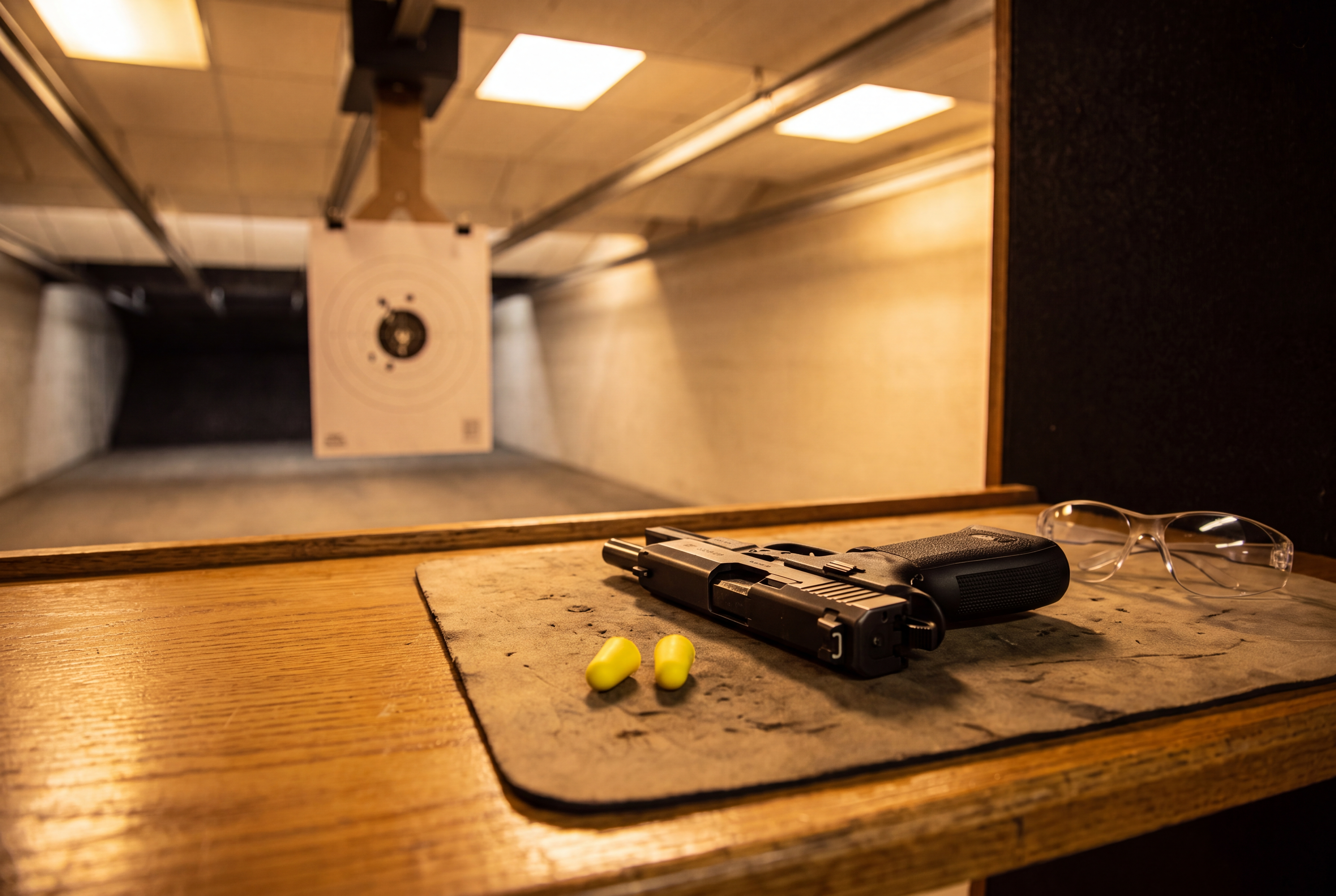
If you remember nothing else from your first day around firearms, remember these four rules. They fit on an index card, experienced shooters run them thousands of times without thinking, and together they have prevented more tragedies than any mechanical safety ever built.
Here they are, plainly:
- Treat every firearm as if it is always loaded.
- Never let the muzzle point at anything you are not willing to destroy.
- Keep your finger off the trigger until your sights are on the target and you have decided to fire.
- Be sure of your target and what is beyond it.
That's the whole foundation. The rest of this guide teaches you how to actually live them — because knowing the words and building the habit are two different things.
Why four and not one? The rules are intentionally redundant. Each one is a backstop for the others. It takes breaking at least two rules at the same time for someone to get hurt — and stacking safety layers like that is exactly the point.
Why the rules overlap on purpose
New shooters sometimes ask why there are four rules when "don't point it at people" seems to cover it. The answer is the single most important idea in firearm safety: layers.
Picture a negligent discharge — a gun firing when nobody meant for it to. For that to injure someone, several things usually have to go wrong at once. The gun was loaded (Rule 1 ignored). It was pointed at a person (Rule 2 ignored). A finger was on the trigger (Rule 3 ignored). Follow even one of the remaining rules and the round goes into a berm, a wall, the floor, or nothing at all — not into a person.
That's why instructors never let you treat any rule as optional "because the gun's unloaded." The rules assume you will eventually make a mistake, and they are designed so that a single mistake is never enough to hurt anyone.
Pro tip: Stop calling it an "accident." The industry term is negligent discharge for a reason — nearly every unintended firing traces back to a rule someone chose to skip, not to a random act of fate. Naming it honestly is the first step to preventing it.
Rule 1 — Treat every firearm as if it is always loaded
This is the mindset rule, and it comes first for a reason. You handle every gun — the one you just unloaded, the "empty" one at the gun counter, the display piece a friend hands you — with the exact same care you'd give a fully loaded one.
Why so extreme? Because "I thought it was unloaded" is the opening line of a huge share of firearm tragedies. Memory is unreliable. Chambers hide a round even when the magazine is out. The only cure is to never let your guard down based on an assumption.
What this looks like in practice:
- Every time a firearm comes into your hands, you perform a chamber check — you open the action, and you look and feel for a round in the chamber and magazine. You verify it yourself, every time, even if someone just showed you it was clear.
- When you set a gun down or hand it to someone, you leave the action open. An open action is the universal "this gun is clear" signal on any range floor, and it lets the next person verify at a glance.
- You never point an "unloaded" gun at anything you wouldn't point a loaded one at. If Rule 1 is real to you, Rule 2 follows automatically.
Warning: The most dangerous words in shooting are "Don't worry, it's not loaded." Treat that sentence as a cue to check the gun yourself — not as permission to relax. A gun you personally cleared and never let out of your hands is the only gun you can call clear, and even then you keep handling it safely.
Checking a firearm you just unloaded isn't paranoia; it's the mark of an experienced handler. The pros double-check precisely because they respect how easy it is to be wrong.
Rule 2 — Never let the muzzle point at anything you are not willing to destroy
The muzzle is the front of the barrel — the business end. This rule is about muzzle discipline: always knowing where your muzzle is pointed and making sure that direction is a safe one.
A safe direction is one where, if the gun fired right now, no person and nothing you care about would be harmed — accounting for the fact that bullets travel through walls, ceilings, and floors, and can ricochet. That means a "safe direction" changes with your surroundings:
| Setting | Usually the safest direction |
|---|---|
| Indoor range | Straight downrange toward the bullet trap/backstop, muzzle level or slightly down |
| Outdoor range | Downrange into the berm |
| At home (handling/cleaning) | Toward an exterior wall backed by dirt, or a dedicated backstop — never a wall shared with a living space |
| Carrying/holstering | Down and away from your own body and others |
Notice "up" is not automatically safe. Indoors, a round fired at the ceiling can travel into another floor. What comes down also has to land somewhere. Think about the whole path, not just the first few feet.
Pro tip: Muzzle awareness is a full-body habit, not just a hand position. Instructors talk about "flagging" — sweeping the muzzle across a person as you turn, reach, or hand off a gun. The fix is to move your feet and body to keep the muzzle downrange, rather than twisting at the wrist and letting the barrel wander across the firing line.
You keep control of the muzzle even if you trip or stumble. That's why you never walk around with your finger in the trigger guard and the gun waving — control of where it points is always your job, and only yours.
Rule 3 — Keep your finger off the trigger until your sights are on the target and you've decided to fire
If Rule 2 controls where the gun points, Rule 3 controls when it can fire. A gun cannot discharge on its own if nothing touches the trigger. Your trigger finger is the last and most reliable safety on any firearm — more dependable than any mechanical lever, because it's under your conscious control.
The correct resting position is called register or "indexing": your trigger finger lies straight along the frame, above the trigger guard, clearly outside it. Not resting lightly on the trigger. Not hovering inside the guard "just in case." Outside, straight, visible.
Here's the part beginners underestimate: under stress, surprise, or a stumble, the human body does something called sympathetic clench — if one hand grips hard (say, to catch your balance), the other hand can involuntarily squeeze too. If that squeezing finger is on a trigger, the gun fires. Keeping your finger in register means a startle response tightens your finger against the frame, not the trigger.
When does the finger move to the trigger? Only when all of this is true:
- Your sights are on the target.
- You have made the decision to fire.
- It is safe and legal to do so.
Until then — while loading, unloading, moving, holstering, or just holding the gun — the finger stays in register.
Warning: "Finger off the trigger" also means off it the instant you're done. New shooters often fire, then leave the finger inside the guard while they lower the gun, look at the target, or turn to talk. Reset to register the moment the shot breaks and you're not immediately firing again.
Rule 4 — Be sure of your target and what is beyond it
The first three rules keep the gun from firing unintentionally. Rule 4 governs the shots you do intend to take. Before you press the trigger, you must positively identify your target and know what lies behind and around it — because a bullet doesn't stop when it hits paper.
Firearms carry far more reach than beginners expect. Per NSSF's published safety guidance, even a .22 short can travel over 1¼ miles, a high-velocity rifle cartridge like the .30-06 can send its bullet more than three miles, shotgun pellets can travel around 500 yards, and shotgun slugs over half a mile. A miss, a pass-through, or a ricochet has to land somewhere.
At a supervised range, the backstop or berm is engineered to be your "what's beyond." That's a big part of why ranges exist and why shooting into an unprepared hillside or "out into the woods" is so dangerous — you can't verify what's on the other side.
Applying Rule 4:
- Positively identify the target. Never fire at a sound, a shadow, a movement, or a "probably."
- Check the backstop. Downrange at the range should always be a proper trap or berm — never open space, another lane's target frame, or the range structure.
- Think past the target. What's downrange if you miss high, low, or wide?
Pro tip: Rule 4 is the rule that reaches beyond the range into home defense and hunting, where there's no engineered berm. In those settings, "know your target and beyond" means being certain of who and what is in the line of fire — including through interior walls — before the decision to shoot is ever made.
"Wait — is it three rules or four?"
Here's the confusion almost every beginner hits, and almost no article resolves: different trusted organizations state the rules a little differently.
| Source | How they frame it |
|---|---|
| NRA | Three fundamental rules: (1) ALWAYS keep the gun pointed in a safe direction, (2) ALWAYS keep your finger off the trigger until ready to shoot, (3) ALWAYS keep the gun unloaded until ready to use — plus additional rules for using and storing firearms |
| NSSF | Four primary rules: safe direction; treat all guns as loaded; finger off the trigger; be sure of your target and beyond (part of a broader 10 rules of safe handling) |
| Jeff Cooper (origin of "the four rules") | (1) All guns are always loaded; (2) never let the muzzle cover anything you're not willing to destroy; (3) keep your finger off the trigger until your sights are on target; (4) be sure of your target |
| Hunter-education courses | Often taught with the memory aid TAB-K: Treat every firearm as loaded, Always point the muzzle in a safe direction, Be certain of your target and beyond, Keep your finger off the trigger |
Look closely and the "disagreement" disappears. These are the same core ideas, grouped and counted a little differently. The NRA folds "know your target" into its broader shooting rules and emphasizes keeping the gun unloaded until use; Cooper and the NSSF break the ideas into four standalone rules. The late Lt. Col. Jeff Cooper is widely credited with popularizing the four-rule format that applies to all firearms at all times — including guns kept loaded for defense.
The takeaway for a new owner: don't get stuck on the count. Internalize the concepts — loaded mindset, muzzle, trigger, target-and-beyond — and you satisfy every version at once.
What the four rules look like on a real firing line
The rules aren't abstract once you're standing in a lane. Here's how they show up minute to minute at a typical supervised range:
- You keep the gun cased and actions open until you're at the bench. Rule 1 and Rule 2 from the moment you walk in.
- You only handle firearms at the firing line, muzzle pointed downrange — never behind the line, never while people are downrange changing targets.
- When a "cease fire" is called, you stop, unload if directed, bench the firearm with the action open, and step back behind the line. You do not touch any gun while anyone is forward of the line.
- You follow the Range Safety Officer (RSO). The RSO's commands exist to enforce these same four rules across everyone on the line at once. Their instructions always take priority.
Pro tip: Posted range rules and RSO commands are not a different rulebook — they're the four rules scaled up to a room full of shooters. If you truly own the four rules, range rules will feel like common sense, not restrictions.
If you've never been, our guide to your first visit to a public gun range walks through check-in, lane etiquette, and the commands you'll hear.
Beyond the four: gear, storage, and the rules the range adds
The four rules govern handling. Two more habits round out a responsible new owner's foundation:
Eye and ear protection. Wear both, every time, from the moment you're on the firing line. Gunfire is loud enough to cause permanent hearing damage, and ejected brass, debris, and unburned powder are real eye hazards. Most ranges require both.
Secure storage. When a firearm isn't in use, it should be stored securely — unloaded, and inaccessible to children and any unauthorized person. Programs like NSSF's Project ChildSafe exist specifically to promote safe, secure storage, and safe storage is increasingly a legal requirement in some jurisdictions.
Note on the law: Storage, transport, and carry requirements vary by state and locality and change over time. Nothing here is legal advice. Always confirm your current local requirements with your state's official resources or a licensed firearms dealer before you buy, carry, transport, or store a firearm.
Finally: use the correct ammunition for your specific firearm, inspect the gun before use, and follow the manufacturer's manual. The right caliber and a mechanically sound gun are safety issues, not just performance ones.
Building the habit
Reading these rules takes five minutes. Making them automatic takes repetition. A few ways to get there faster:
- Say them out loud while you handle an unloaded gun at home (having triple-checked it's clear, muzzle in a safe direction).
- Practice register — draw your trigger finger to the frame every single time you pick a gun up, until it's the default.
- Take a class. A beginner course with a qualified instructor turns these words into muscle memory under real supervision. Our guide to firearm training classes for beginners covers what to expect.
- Watch experienced shooters. Notice how their actions stay open, muzzles stay downrange, and fingers stay in register without a second thought. That's the goal.
The four rules never expire and never get "advanced." The most seasoned shooters on any line are running the same four rules you just learned — that's exactly why they're still safe after decades. Learn them, live them, and you belong on that line too.
Frequently Asked Questions
What are the 4 rules of gun safety?
Treat every firearm as if it's always loaded; never point the muzzle at anything you're not willing to destroy; keep your finger off the trigger until your sights are on target and you've decided to fire; and be sure of your target and what's beyond it.
Who created the four rules of gun safety?
The modern four-rule format is widely credited to the late Lt. Col. Jeff Cooper, who popularized a single set of rules meant to apply to all firearms at all times. Organizations like the NSSF and NRA teach closely related versions.
Why do some sources list three rules and others list four?
They emphasize and group the same ideas differently. The NRA states three fundamental handling rules (safe direction, finger off trigger, unloaded until ready) plus additional shooting and storage rules, while the NSSF and Cooper break the concepts into four standalone rules. Learn the concepts and you cover every version.
What does "keep the muzzle in a safe direction" mean indoors?
A safe direction is one where a fired round couldn't hurt anyone, accounting for walls, floors, ceilings, and ricochets. At an indoor range that's straight downrange toward the backstop. "Up" isn't automatically safe indoors, because a round can travel into another floor.
What's the difference between a negligent discharge and an accidental discharge?
An accidental discharge implies a mechanical failure with no user error. A negligent discharge — far more common — is an unintended firing caused by someone breaking a safety rule, like a finger on the trigger or failing to check the chamber. The four rules are designed to prevent the negligent kind.
Are the four rules the same as the range's rules?
Range rules and Range Safety Officer commands are the four rules scaled up to keep everyone on the line safe at once. If you follow the four rules, posted range rules will feel like common sense.
Do the four rules apply to an unloaded gun?
Yes — that's the entire point of Rule 1. You handle every firearm as if it's loaded, so you're never caught off guard by a round you forgot about or didn't know was there.